
Sensors 101
A quick overview of sensors
TECHNOLOGY
Atanu
11/19/20253 min read
Sensors: Types, Technologies, and Selection Criteria
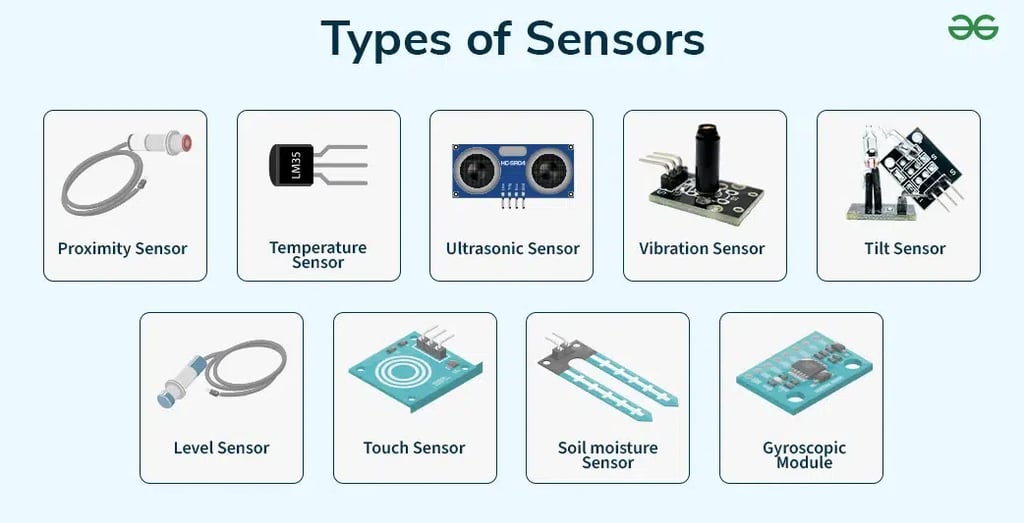
Sensors are fundamental to automation systems, enabling the detection of parameters such as temperature, humidity, pressure, movement, light, proximity, touch, level, and vibration. The performance and reliability of an automation system depend heavily on the quality and suitability of its sensors.
Sensor Classifications
Active Sensors: Contain an internal energy source for detection.
Passive Sensors: Operate using ambient energy sources.
Analogue Sensors: Provide continuous output proportional to the measured parameter; ideal for applications requiring precise, real-time monitoring. They offer higher accuracy but are more susceptible to environmental noise and are generally more expensive.
Digital Sensors: Output discrete levels, typically binary (0 or 1). These are well-suited for detecting presence or absence and are more cost-effective and resistant to noise, though less accurate than analogue sensors.
EXP - Sensors also have a very technical name - Transducers. Transducers convert one form of parameter in to another type of parameter that can be processed by the technology or circuit that is being used. For example - a motion sensor may use changes in temperature of the ambient environment to sense a movement and output a voltage value.
Common Sensor Types – In Home or Office
Light Sensors: Used in automated lighting systems to measure light intensity and control lighting based on thresholds. Light intensity is measured in LUX.
Motion Sensors: Detect movement within their field of vision, commonly using PIR (Passive Infrared) technology in security systems. A more detailed review can be found in a later section.
Proximity Sensors: Identify nearby objects, often using inductive technology. As the object nears the sensor, there is a change in induced magnetic field. The change is used to drive the desired output.
Vibration Sensors: Convert mechanical movement into electrical signals, used in vehicles and security devices.
Smoke Sensors: Use ionisation or photoelectric technologies to detect fire. Ionisation sensors are effective for fast-flaming fires, while photoelectric sensors are better for slow, smouldering fires.
Gas Sensors: Monitor hazardous gases such as carbon monoxide, triggering alarms when dangerous levels are detected. The most common is the Carbon Monoxide (CO) alarm used in residences for gas leak detection. CO is known as the silent killer hence extremely important to install in any residence or office. CO does not have a recognizable smell, colour or taste.
EXP –CO sensors operate by changing the electrical current levels based on the permeation of CO levels in the electrolyte, but Metal Oxide sensors instead of a chemical solution rely on electrical circuitry. As carbon monoxide meets a sensor’s chip, it lowers the material’s resistance to the flow of electricity to a degree that depends on the concentration of the chemical present in the air.
Motion Sensor Technologies – A key element in Home Security System
PIR Sensors: Detect infrared temperature changes from warm-blooded organisms; best for indoor use.
Microwave Sensors: Use microwave radiation to detect motion, overcoming some PIR limitations.
Dual Technology Sensors: Combine PIR and microwave detection for enhanced accuracy.
Ultrasonic Sensors: Employ ultrasonic waves for motion detection.
Tomographic Sensors: Use multiple nodes and radio waves to detect movement, even through walls. Instead of a single sensor, tomographic motion detectors use several nodes placed throughout a space. These nodes communicate with one another. When something enters the field between them, it disturbs the links, signalling movement. Tomographic sensors can be completely hidden because they don’t rely on line of sight the way other sensors do. Common usage is in industrial application like large warehouses.
Video Motion Sensors: AI-powered cameras analyse video frames to detect human presence.
Hybrid sensors may also be used, depending on specific requirements for placement and accuracy.
Sensor Selection: Key Considerations
Selecting the right sensor for an application involves evaluating several factors:
Parameter to be Measured: Identify the physical quantity (e.g., temperature, motion, gas concentration) relevant to your application.
Accuracy and Precision: Determine the required measurement accuracy. Analogue sensors are preferable for high-precision needs, while digital sensors suffice for binary detection.
Environmental Conditions: Consider exposure to noise, temperature fluctuations, humidity, and other environmental factors. Some sensors are more robust against interference.
Response Time: Assess how quickly the sensor must react to changes. Fast response is critical in safety and security applications.
Integration and Compatibility: Ensure the sensor’s output is compatible with your system’s processing hardware or software.
Cost and Maintenance: Balance performance requirements with budget constraints and maintenance needs. Some advanced sensors may require regular calibration or servicing.
Physical Placement: Evaluate installation constraints, such as line-of-sight requirements, mounting options, and accessibility for maintenance.
Regulatory and Safety Standards: For applications involving hazardous environments (e.g., gas or smoke detection), ensure compliance with relevant standards.
Communication Protocols: What the protocols available with a sensor and its combability with our systems. A remote monitoring system would need wi-fi and internet connectivity.
A thorough understanding of the sensor’s technology and the operational context is essential for optimal selection. A discussion with an expert is advisable before decision making.
Feel free to use the comment section for any questions. More on sensors later, Adios!
Explore
Join me in this fascinating journey
Connect
stay updated
© 2025. All rights reserved.